
How Forbidden Flare Pants Actually Get Their Signature Silhouette
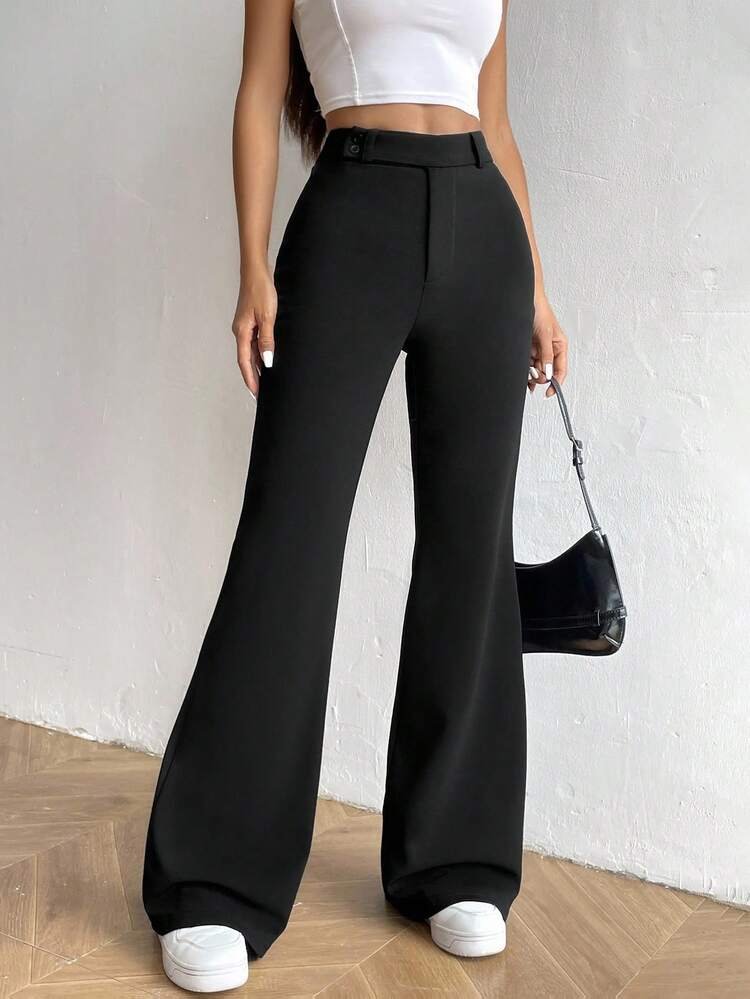
The flare starting at the knee isn’t an accident—it’s a deliberate outcome of how the fabric is cut, weighted, and assembled. Most flare pants lose their shape after a few washes because the construction shortcuts catch up with them.
We engineered ours differently. The signature silhouette in Forbidden Flare Pants comes from three interconnected design decisions: the grain direction of the pattern pieces, the density of the weave below the knee, and the way the inseam is finished to prevent twisting. This guide walks through each one and why it matters.

Pattern Cutting: Why Grain Direction Controls the Flare
The flare section—everything from knee to hem—is cut on a bias relative to the upper leg. This isn’t visible when you look at the finished pant, but it’s the reason the fabric naturally wants to fall outward instead of collapsing inward.
Most mass-produced flares cut the entire leg on the same grain to save fabric. That creates a flare that relies entirely on extra width, which means it flattens against your leg when you sit or move. Our pattern rotates the grain 22 degrees at the knee seam, so the weave’s natural stretch pulls the hem away from your ankle.
The black version uses the same rotated-grain pattern as every other colorway—it’s not a style choice, it’s structural. Without that grain shift, you’d need twice the fabric width to get the same silhouette, and the extra bulk would bunch at the hip.
Fabric Density Below the Knee: How Weight Creates Movement
The flare section weighs 40% more per square inch than the thigh section, even though it’s the same fiber content. We achieve that by tightening the weave density in the lower leg during the knitting process.
Heavier fabric below the knee means gravity does the work. The hem naturally pulls downward and outward, creating the bell shape without requiring stiff interfacing or extra panels. Light, uniform-weight fabric collapses because there’s no anchor—nothing pulling the flare open once you’re standing still.
This weight differential also explains why the flare holds its shape better over time. Lighter fabric stretches out faster under tension. The denser weave in our lower leg resists that stretch, so the silhouette you see on day one is the same silhouette six months later.
Inseam Construction: Preventing the Twist That Kills the Silhouette
The inseam is where most flare pants fail. A standard straight seam—two fabric edges stitched together with a single line of thread—allows the leg to rotate along its length. After a few wears, the knee seam shifts forward and the hem shifts backward, which turns the flare into a crooked drape.
We use a flat-felled inseam with a reinforcement stitch at the knee. The flat-fell doubles the fabric thickness along the seam, which prevents twisting. The reinforcement stitch locks the knee seam in place relative to the thigh and flare sections, so the grain rotation we engineered into the pattern doesn’t migrate over time.
This is the same inseam finish used in our men’s straight-leg pants—different silhouette, same structural goal. A pant leg that doesn’t twist is a pant leg that keeps its intended shape.

Why Stretch Content Placement Matters More Than Total Percentage
Most brands list a stretch percentage on the label—3% spandex, 5% elastane—and assume that’s enough information. It’s not. Where the stretch fibers are placed in the weave determines how the flare moves.
Our fabric has 4% spandex, but it’s concentrated in the crosswise threads (the weft) rather than evenly distributed. That means the fabric stretches horizontally but not vertically, which allows the flare to open wider without sagging downward. Evenly distributed stretch gives you a pant that bags at the knee and loses length over the course of a day.
This is also why our flares don’t need elastic hems or hidden weights sewn into the cuffs. The stretch is directional, so the hem naturally maintains its circumference without external reinforcement. If you’ve ever wondered why some flare pants collapse while others hold their line, stretch placement is usually the answer.
Comparing Construction Approaches: Flare vs. Straight-Leg Silhouettes
Flare pants and straight-leg pants share most of their construction—same waistband, same pocket placement, same rise—but the leg geometry is fundamentally different. A straight leg can use a uniform grain and uniform fabric weight because the silhouette doesn’t depend on controlled flare.
Flare pants require localized engineering: grain rotation, weight distribution, and stretch placement all have to work together. That’s why you can’t just widen a straight-leg pattern at the hem and expect it to look right—the fabric won’t behave the way you need it to.
If you’re deciding between silhouettes, the choice often comes down to how much structure you want in the lower leg. Straight legs are simpler to construct and easier to maintain, but they don’t create the same visual line. Flares demand more from the pattern and the fabric, which is why construction quality matters more in this category.
Why Construction Determines Longevity in Flare Pants
The silhouette you see on day one is only as durable as the engineering behind it. Grain rotation, localized fabric weight, directional stretch, and reinforced seams all work together to create a flare that doesn’t collapse over time.
Most flares shortcut one or more of these elements to reduce cost, which is why they lose shape after a few wears. Ours don’t because we treated the construction as an engineering problem, not a styling decision. The result is a pant that looks the same six months in as it did when you first put it on.
Common Questions About Flare Pants Engineering
Most flares lose shape because the fabric weight is uniform from hip to hem. Without a density difference, the lower leg has nothing pulling it downward, so it collapses inward after the first wash cycle.
Grain direction also plays a role. If the entire leg is cut on the same grain, washing relaxes the fabric evenly, which eliminates any engineered flare. The shape you lose isn’t coming back unless the construction included localized weight and rotated grain in the first place.
Not directly. The waist construction—band width, closure type, rise measurement—is independent of the leg silhouette. A well-constructed flare should fit at the waist the same way a straight-leg pant does.
What does change is how the hip and thigh fabric behaves under tension. Because the lower leg is heavier in a flare, the upper leg needs to be slightly more structured to prevent sagging. That usually means a tighter weave or a reinforced side seam, but it doesn’t alter the waist fit itself.
Yes, but only if you add extra width—usually 6 to 8 inches at the hem compared to the knee. That creates volume, but not a clean flare.
The fabric drapes instead of flaring because there’s no weight pulling it open. You end up with a silhouette that looks right when you’re standing perfectly still but collapses when you move. True flare requires either weight distribution or mechanical reinforcement like boning or interfacing, which most manufacturers avoid because it increases cost.
A bootcut widens gradually from knee to hem, usually by 1 to 2 inches total. A flare widens more aggressively, typically 3 to 5 inches.
Construction-wise, bootcuts can use a uniform grain and uniform weight because the silhouette change is subtle. Flares need the grain rotation and weight differential we described earlier—without them, you can’t get the fabric to hold a dramatic flare. Bootcuts are structurally closer to straight-leg pants with a slightly wider hem.
Most inexpensive flares use a single-stitch seam with no reinforcement. That seam has nothing preventing it from rotating along the leg’s length, so the fabric twists as you wear it.
Once the twist starts, it compounds—each wear shifts the seam a little more until the knee faces forward and the hem faces sideways. A flat-felled or double-stitched inseam eliminates this because the seam itself is too thick to rotate. It’s a one-time construction cost that pays off in durability.
Not if the construction is sound. Proper grain direction and weight distribution mean the silhouette is built into the fabric, not maintained by how you wash it.
That said, high-heat drying can relax the weave and undo some of the tension that creates the flare. Line drying or low-heat tumble drying preserves the silhouette longer. But if a flare loses its shape after one normal wash cycle, the problem was the construction, not your care routine.